If you have been told you need a dental implant, or are considering one, it is natural to want to know exactly what will happen. Will there be surgery? Will it hurt? How long will it take, and how many visits are needed?
This article explains the process without unnecessary technical language, so you can attend your first consultation with a clearer understanding.
First, what exactly is a dental implant?
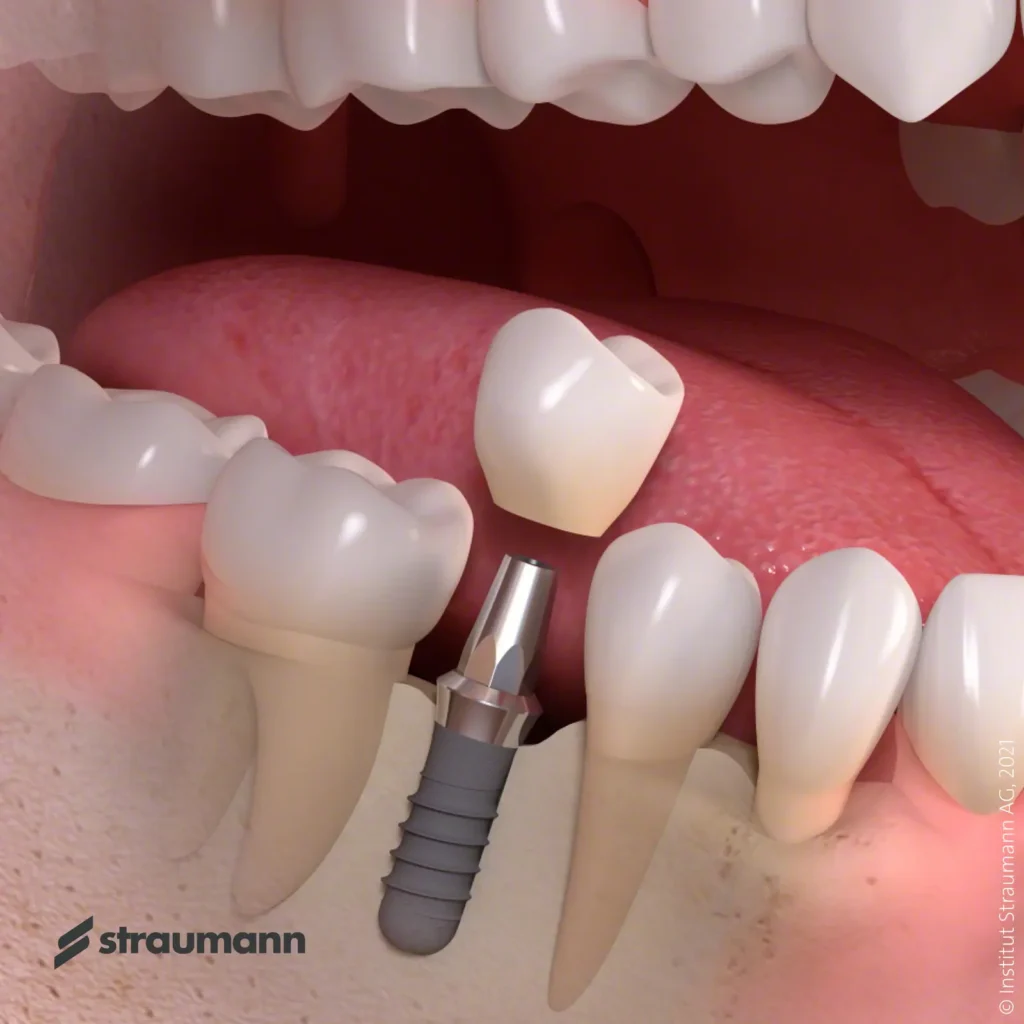
Many people think the implant is the tooth visible at the end. In fact, it is the screw anchored in the upper or lower jawbone that acts as an artificial root. A crown is subsequently fitted over it: the visible tooth-like part used for chewing.
Titanium is the most commonly used implant material because of its biocompatibility. During osseointegration, bone heals around the surface and provides stability. The outcome depends on more than the brand: diagnosis, implant position, general and periodontal health, smoking, hygiene and follow-up also matter. At CHC Clínica Dental, we use Straumann implants and choose the design and components according to each case.
How is a dental implant placed? The complete process
Step 1: Assessment and diagnosis
First, we establish the reason for tooth loss and assess the teeth, gums, bite and general health. X-rays and three-dimensional imaging are requested when needed to analyse bone volume and anatomical structures.
This information helps determine whether an implant is a reasonable option, where it could be placed and whether preliminary procedures are necessary. Digital planning supports treatment design but does not replace examination or guarantee an exact result.
Step 2: Preparation, if needed
Before placement, infection may need treatment, periodontal disease may need control, or a tooth with a poor prognosis may need extraction. In selected cases, extraction and implant placement can take place together; in others, waiting for healing is preferable.
If available bone does not allow an appropriate position, bone regeneration or sinus elevation may be considered. The procedure, material and healing time depend on the defect. These techniques can add several months and are not indicated in the same way for every patient.
Step 3: Implant placement surgery
Surgery is usually performed under local anaesthesia. The aim is to prevent pain, although pressure or vibration may be felt. Sedation may be considered for selected patients after reviewing their health and the necessary conditions.
In simplified terms, the procedure involves:
- Accessing the bone using a technique adapted to the case.
- Preparing the implant site in the planned position.
- Placing the implant and checking its stability.
- Protecting the area and placing sutures when needed.
Duration depends on the number and position of implants, anatomy and any additional procedures. Surface and brand form part of system selection, but cannot guarantee faster healing for everyone.
Step 4: Osseointegration
After placement, bone heals around the implant. The time needed varies with initial stability, bone quality, the treated area, associated procedures and patient factors.
An immediate temporary restoration may be possible in selected cases, but “same-day teeth” does not mean treatment is finished or that the implant can withstand any load. Suitability and restrictions are decided individually.
Hygiene, diet and follow-up instructions are provided during this stage. Contact the clinic if pain increases or significant swelling, discharge or mobility develops.
Step 5: Uncovering and placing the healing abutment
Once the implant has integrated, a small procedure may be used to expose its head through the gum and fit a healing abutment. This component helps shape the gum for the final crown and its appearance.
When indicated, we use original components compatible with the implant system. Abutment selection, prosthetic fit and maintenance help reduce complications, but no component can promise zero risk.
The gum usually needs a few weeks to heal and take shape after the healing abutment is placed; the timing is adjusted to the individual case.
Step 6: Impressions and crown fabrication
Once the implant is integrated and the gum has healed into shape, the final crown can be made. An impression, using conventional material or an intraoral digital scan, is sent to the dental laboratory.
The crown is made to measure, with a colour, shape and size suited to the other teeth for a natural-looking result. This process usually takes two to four weeks.
Step 7: Fitting the final crown
The healing abutment is removed and the final crown fitted to the Straumann implant. The clinician checks the fit, bite and appearance, making final adjustments if needed.
The restoration needs brushing, adapted interdental cleaning and reviews. The team will show you how to reach the areas around the implant according to the design of your restoration.
How long does the whole process take?
Duration is an estimate. Without preliminary procedures, several months may be needed between surgery and the final restoration. Bone regeneration, sinus elevation, periodontal treatment or other needs can extend the timetable.
Progress is assessed before moving between stages. A planned date is not a guarantee: it may change according to healing and clinical response.
Does having an implant hurt?
Surgery usually uses local anaesthesia to prevent pain, although pressure or vibration may be noticeable. Tell the clinician about unexpected discomfort so they can check the anaesthesia and respond.
Swelling, sensitivity or bruising may occur during the first few days. Medication is prescribed according to medical history and the procedure; the same anti-inflammatory is not suitable for everyone. Severe or increasing pain, or pain accompanied by other signs, should be reported to the clinic.
When is a special assessment needed?
Not every missing tooth needs an implant, and not every patient can have surgery immediately. Periodontal status, bone, hygiene, smoking, diabetes, medication, medical history and treatments such as radiotherapy must be reviewed first.
- Insufficient bone: regeneration, an alternative position or another prosthetic solution may be needed.
- Active periodontitis: it must be treated and controlled before considering an implant.
- Uncontrolled diabetes or certain illnesses: these can affect healing and require medical coordination.
- Smoking: it increases complication risk and should be addressed before and after surgery.
- Radiotherapy, antiresorptive medication or other relevant history: these require individual assessment.
- Growing patients: placement usually waits until facial development has finished.
When an implant is not advisable, options may include a bridge, removable denture, maintaining the space or, in selected situations, not replacing the tooth. The choice depends on function, appearance and neighbouring teeth.
How many implants can be placed?
There is no single number for everyone. Space, bone, the restoration to be supported, general health and the ability to maintain hygiene all matter. For full-mouth rehabilitation, number and distribution are planned for the anatomy and prosthetic design; terms such as “All-on-4” do not replace diagnosis.
What to check in the estimate
The implant brand is only one part of treatment. It is also important to understand what the estimate includes and how follow-up will work.
- Diagnostic tests and planning.
- Implant, components and restoration type.
- Any extraction, bone regeneration or temporary restoration needed.
- Estimated number of visits and stages.
- Maintenance, hygiene and subsequent reviews.
- Circumstances that could change the plan or cost.
At CHC Clínica Dental, we use Straumann implants when indicated, within a plan considering biology, prosthetic position and maintenance.
Frequently asked questions about implant placement
Can the implant be seen from outside? The implant sits within the bone; the restoration is the visible part. During healing, a component or temporary restoration may be present depending on the technique.
Does an implant last for life? A specific lifespan cannot be guaranteed. Health, hygiene, smoking, bite, the restoration and maintenance influence its course. The crown and other components may also need repair or replacement.
When can I eat normally again? Advice depends on the surgery and whether there is a temporary restoration. Initially, protecting the area and progressing the diet according to professional instructions is usually recommended.
How is it cleaned? Brushing, adapted interdental cleaning and reviews are needed. Care is not identical in every case; the team should show you how to clean around your restoration.
Can an implant be “rejected”? Failure is not usually immune rejection like that of a transplant. It can result from insufficient osseointegration or biological or mechanical complications. Risk is assessed individually.
Considering a dental implant in Barcelona?
At CHC Clínica Dental, we can assess the cause of tooth loss, bone, gums and bite to explain whether an implant is an option and what alternatives exist.
Request an assessment for a staged plan, an estimated timetable and a clearly explained estimate.


