When several teeth are missing, teeth keep breaking or chewing has become uncomfortable, it is easy to think that the only solution is to “remove everything and start again”. Full-mouth rehabilitation does not necessarily mean extracting every tooth. It means assessing the mouth as a whole and organising treatments so that everything can function together again.
The important decision is not to choose a number of implants first. It is to understand which teeth have a future, what is causing the deterioration and which solution will let you eat, speak and smile comfortably. It also needs to fit the care you will be able to maintain at home.
What is full-mouth rehabilitation?
It is a coordinated plan to restore function and appearance in a mouth with several problems. It may involve one arch—the upper or lower teeth—or both. It is not a single procedure: it may combine gum treatment, restorations, crowns, implant-supported prostheses and other procedures when indicated.
Two mouths with a similar appearance may need different plans. Tooth wear where the remaining teeth are still healthy is not treated in the same way as tooth loss caused by periodontitis. A loose removable denture also calls for a different approach from several old crowns that no longer fit.
When are teeth preserved and when are they extracted?
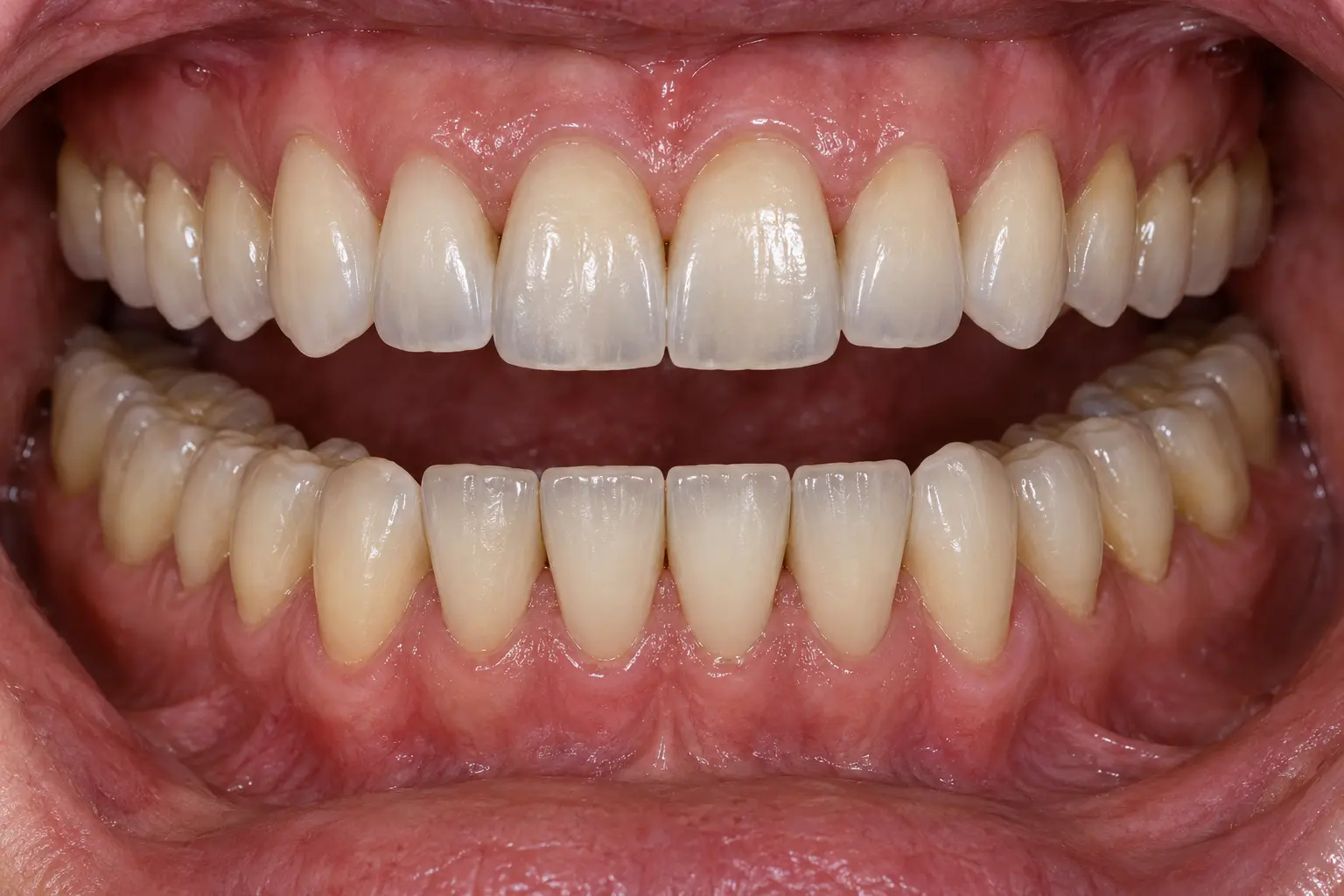
The examination assesses each tooth: how much healthy tissue remains, the condition of its roots, its bone and gum support, whether infection is present, and whether it can be cleaned and restored. Its role in the overall plan is then considered. The age or appearance of a tooth alone does not answer all these questions.
The EFP recommendations for advanced periodontitis include different rehabilitation approaches according to which teeth can be maintained. Extraction is irreversible: before proceeding, you should understand why a tooth cannot be preserved and what alternatives exist.
Conversely, keeping a tooth with infection or a very poor prognosis is not always the best decision. A reasoned plan explains both aspects: what the team will try to preserve and what should not be used to support a larger rehabilitation.
Which solutions can be combined?
Restorations on your natural teeth
If maintainable and restorable teeth remain, they may be rebuilt with direct restorations, partial restorations or crowns, depending on the damage. They do not all require the same coverage. Before choosing shape and colour, it is important to understand why they deteriorated and whether the bite provides enough space to restore them.
Fixed implant-supported prostheses
Implants can support replacement teeth when teeth are missing or cannot be preserved. In an arch without teeth, several implants can support a complete prosthesis; one implant is not needed for every missing tooth. “Fixed” means that you do not remove it yourself, although the clinical team may need to remove it for certain checks or repairs.
Prostheses removed for cleaning
A removable prosthesis may also form part of a plan. Some are stabilised by attachments on implants. Ease of cleaning, lip support, manual dexterity and personal preferences matter when comparing them with a fixed prosthesis. The right option is not decided by the word “fixed” alone.
The EFP visual guide to rehabilitation summarises these alternatives according to the available support. Having teeth and implants in the same mouth does not mean they have to be joined within one bridge.
How many implants do I need for fixed teeth?
It depends on the bone, its distribution, the intended prosthesis, the teeth in the opposing arch and access for cleaning. Commercial names or plans using four or six implants describe particular strategies; they do not replace an individual assessment.
The ITI consensus on complete-arch fixed prostheses recommends planning the prosthesis before surgery and considering the consequences of possible future complications. Asking for “the maximum number of implants” or “as few as possible” does not by itself guarantee a better result.
Will I be without teeth during treatment?
This question should be answered before treatment begins. A plan may include fixed or removable temporary teeth adapted to each stage. Explain whether you work with the public, are concerned about speaking, or found a previous prosthesis difficult to tolerate.
Temporary teeth serve an important purpose, but they have limitations. They may require adjustments and a modified diet. If there are grafts or recent wounds, they should not press on those areas. It is useful to know what you will wear when you leave each appointment and what to do if the temporary prosthesis is uncomfortable or breaks.
Are “teeth in a day” the final teeth?
Not necessarily. Implant placement and placing teeth on the implants are separate decisions. In selected patients, a temporary prosthesis may be fixed on the day of surgery or shortly afterwards. This is known as immediate loading and requires favourable conditions, including adequate implant stability.
The ITI evidence on immediate loading supports its use with careful patient selection and planning. It does not mean that the bone has already healed or that any food can be chewed. When the necessary conditions are not present, waiting protects the treatment.
The stages of full-mouth rehabilitation
1. Listen and assess
The starting point is what you need to regain. The examination, photographs, bite records and indicated imaging allow the plan to be built. Bring a list of what you find difficult: cutting food, chewing on one side, pronouncing certain words or smiling without covering your mouth.
2. Control active problems
Tooth decay, infections and gum disease are treated before relying on the mouth to support a definitive rehabilitation. If periodontitis is present, improvement is checked at reassessment. Changing the visible teeth without addressing what supports them leaves an essential part of the problem unresolved.
3. Prepare the supports and temporary teeth
The agreed treatments are carried out: restorations, necessary extractions, implants or bone reconstruction where appropriate. Each stage should have a specific purpose. When bone is limited, you can read our guide to dental implants with limited bone and alternatives to grafting.
4. Test function and appearance
Before the definitive finish, the way the teeth fit together and how they feel in use are checked. This is the time to say if a shape does not feel right, if a sound is difficult to pronounce or if the bite feels unusual. Planning images help the discussion, but they do not replace testing in the mouth.
5. Place the definitive rehabilitation
The final stage includes the necessary checks and adjustments. With implant treatment, healing can extend the process over several months. Timeframes should be given as estimates and reviewed if healing changes; promising a fixed date before diagnosis is not useful.
6. Learn how to maintain it
Ask the team to show you how to clean the prosthesis while it is in place and to check that you can do this. Fixed teeth do not remove the need for check-ups. The tissues around the implants, as well as the materials, screws and prosthetic components, all need monitoring.
Frequently asked questions
Can I rehabilitate one part of my mouth first?
Sometimes. Treatment may be arranged in stages, provided each one fits the final result. Ask what can be brought forward, what needs to wait and how the completed and pending areas will function together. Phased care should not mean making isolated decisions.
Do implants prevent gum disease from returning?
No. Inflammation and bone loss can also occur around implants. The EFP guideline on peri-implant diseases gives particular attention to prevention and maintenance. A history of periodontitis makes follow-up especially important.
Will I need to change how I eat or speak?
Changes may be needed during adaptation and healing. The shape of the teeth and prosthesis also affects how the mouth feels. Explain any difficulty at follow-up visits: you do not have to assume that persistent discomfort is something you must tolerate.
What happens if one part breaks?
The solution depends on what has been damaged. Repairing a material or component is different from managing a problem with the implant itself. Ask for a maintenance plan and a way to contact the clinic. Do not try to glue a prosthesis or adjust its screws at home.
A plan you can understand before deciding
At CHC Clínica Dental, we approach full-mouth rehabilitation as a whole: teeth, gums, bite and prosthesis. The assessment is an opportunity to explain what can be preserved, what should be replaced and in which order. You can ask for the plan to distinguish necessary stages from possible alternatives.
Message us on WhatsApp to request an assessment in Barcelona. You do not need to have chosen a treatment before contacting us.
Clinical sources and further reading
EFP and ITI references are linked in the relevant sections. Further information: Guy’s and St Thomas’: dental implants and tooth-replacement options; Leeds Teaching Hospitals: prostheses, healing and care. Consulted on 13 September 2026. This guide does not replace an individual diagnosis.


